




Sovereignetics
CURRENTLY UNDER CONSTRUCTION
Investigate a reality that actually fits







applied sovereignetics
Applications
From ontology to real-world application
Explore how Sovereignetics can be applied to contemporary challenges, technological systems and organisational structures. These applications investigate how participation, consequence and responsibility can be understood, designed and improved in practice.








Applications > Artificial Intelligence
applied sovereignetics
Artificial Intelligence
Beyond capability. Towards consequence intelligence.
Artificial intelligence is generally evaluated through capability, performance and accuracy.Sovereignetics investigates the consequences artificial systems generate through participation, and where responsibility for those consequences reside.This page examines artificial influence, responsibility architecture, oversight and the conditions required for consequentially coherent AI systems.
Featured Publication
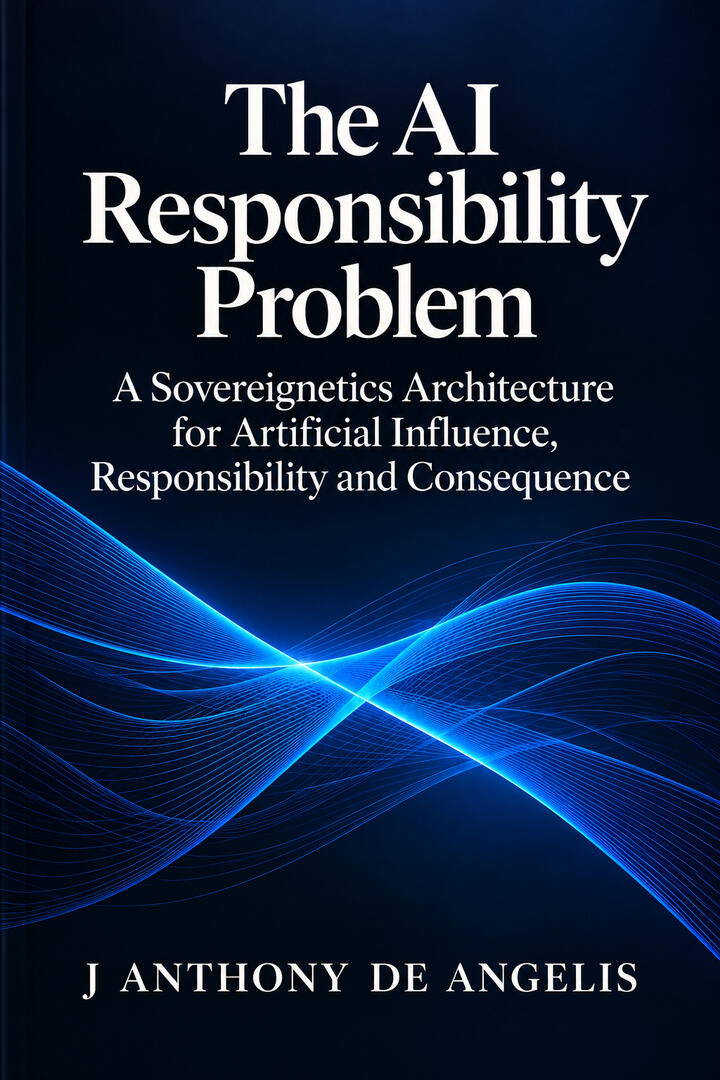
The AI Responsibility Problem
A SOVEREIGNETICS ARCHITECTURE FOR ARTIFICIAL INFLUENCE, RESPONSIBILITY AND CONSEQUENCE
A comprehensive investigation of artificial intelligence through the lens of participation, consequence and responsibility.This proposed flagship publication develops a complete architectural framework for understanding and managing artificial influence.
Artificial Intelligence - Articles
How Do We Keep AI in Check?
Artificial intelligence is becoming more capable. That immediately produces a familiar question:
How do we keep it in check?
Read article
Does Human Oversight Actually Mean Human Control?
One of the most common safeguards proposed for artificial intelligence is human oversight.
AI can recommend, analyse, prioritise, and automate. But somewhere in the process, a human remains involved. This is usually reassuring, it shouldn't always be.
Read article
Who is Responsible When AI Makes the Decision?
When an artificial intelligence system contributes to a harmful decision, one question usually follows quickly: Who is responsible? The developer? The company that deployed it? The employee who relied on it? The person who approved the final action? The organisation that purchased it? Or, if the system acted autonomously, the AI itself?
Read article
Can We Outsource Our Decisions to AI?
One of the great promises of artificial intelligence is convenience.
AI can write for us, search for us, organise for us, analyse information for us, recommend for us, plan for us. And increasingly, decide for us. At first, these appear to belong to the same trajectory. If a machine can perform a task faster and better than we can, why wouldn't we let it?
Read article
Can an AI Be Responsible?
As artificial intelligence becomes more autonomous, one question becomes increasingly difficult to avoid: Can an AI itself be responsible for what it does? If an AI makes a decision, performs an action and produces a consequence, it may seem reasonable to attach responsibility to the AI.
Read article
What Happens When AI Systems Influence Each Other?
Most discussions about AI responsibility still assume a relatively simple relationship. A human uses an AI. The AI produces an output. Something happens. We can then ask who authorised the system, who acted on its output, and who is responsible for the consequence.
Read article





Applications > Organisations
applied sovereignetics
Organisations
From structure to participatory responsibility.
Organisations are networks of participation, consequence and responsibility.Sovereignetics can be applied to organisational systems to understand how participation is structured, how influence propagates and where responsibility should reside.This page examines governance, decision-making, organisational design, systemic risk and how to build organisations that are consequentially coherent.
Featured Publication

The Hidden Architecture of Organisations
A SOVEREIGNETICS ARCHITECTURE FOR INFLUENCE, RESPONSIBILITY, CONSEQUENCE AND CORRECTION
A comprehensive investigation of organisational systems through the lens of participation, consequence and responsibility.This publication develops a complete architectural framework for understanding, designing and correcting organisational structures that are consequentially coherent.
Organisations - Articles





Applications > Individual
applied sovereignetics
The Individual
Understanding participation, authorship and becoming.
Sovereignetics examines the individual through participation rather than fixed identity.Our choices, relationships, environments and accumulated consequences influence how we participate and who we become.This page investigates recurring patterns, protective responses, personal sovereignty and the conditions through which individuals can recognise and reorganise their participation.
Featured Publication
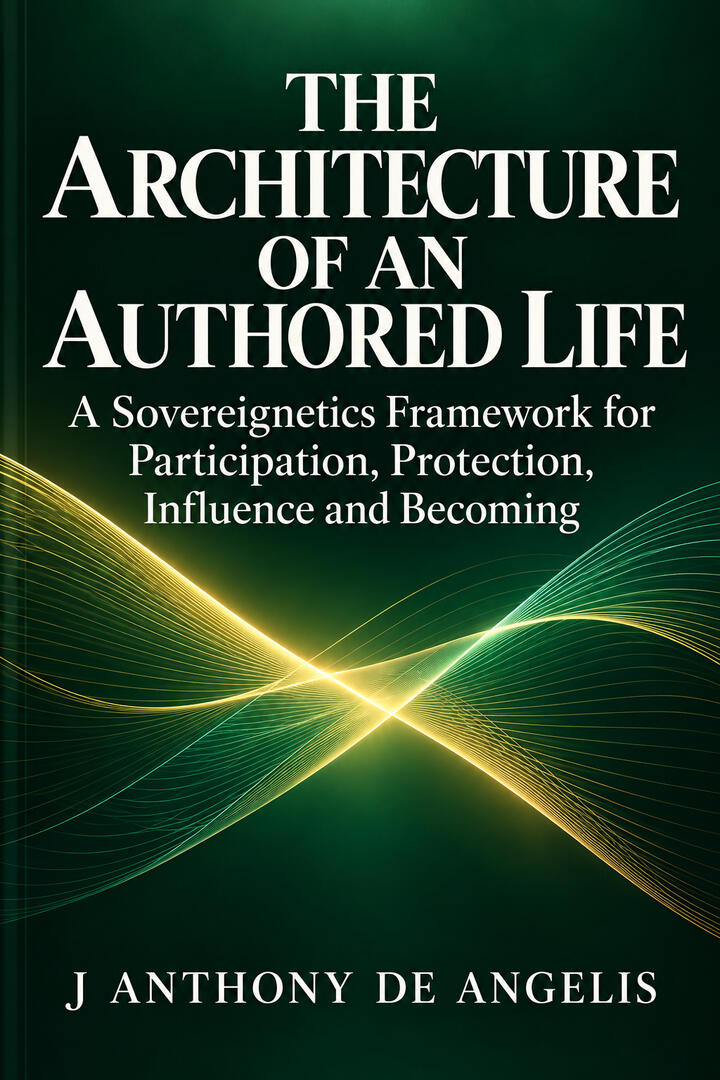
The Architecture of an Authored Life
A Sovereignetics Framework for Participation, Protection, Influence and Becoming
An examination of how individual lives are shaped through participation, protection, influence and consequence. Drawing on the Sovereignetics framework, this book explores the conditions under which a person can recognise inherited patterns, reorganise their participation and take greater responsibility for the direction of their becoming.
The Individual - Articles





Applications > Relationships
applied sovereignetics
Relationships
Beyond behaviour. Understanding relational architecture.
Relationships are architectures formed through repeated participation and accumulated consequence.Sovereignetics examines how individuals generate shared conditions, how relational patterns stabilise, and how influence, responsibility and consequence move between participants.This page investigates conflict, dependence, protective patterns, relational change and the conditions through which relationships either expand or restrict individual participation.
Featured Publication

The Architecture Between Us
A Sovereignetics Framework for Shared Participation, Relational Authority and Plural Authorship
An examination of how relationships develop through shared participation, influence and accumulated consequence. Drawing on the Sovereignetics framework, this book explores how relational architectures emerge, how authority and responsibility become distributed between participants, and how two individuals can establish a shared direction without surrendering their individual sovereignty or authorship.
Relationships - Articles
How Do We Keep AI in Check?
Artificial intelligence is becoming more capable.
That immediately produces a familiar question:
How do we keep it in check?
Most answers focus on restricting what AI can do.
Keep humans in the loop. Limit access. Require authorisation.
Monitor outputs. Establish rules.
Prevent certain actions. Retain shutdown mechanisms.
All of these may be necessary.
But they leave a deeper problem unresolved.The danger is not simply what an AI system is capable of doing.
It is what that capability is allowed to influence.An AI may never be given final authority over a decision and still
substantially determine what that decision becomes. It may decide
what information a human sees, what gets prioritised, which options are presented, which risks are detected, which applicants are flagged, which actions are recommended, or which possibilities never reach the human decision-maker at all.
The human may technically make the final decision.
But that does not tell us where the influence was.This is where keeping AI “under human control” becomes more
complicated than it first appears.
Control is not the same as oversight
Imagine an organisation uses AI to assess thousands of cases.
The AI does not make the final decision. Instead, it produces a
recommendation that a human employee approves or rejects.Formally, the human remains in control.But suppose employees approve the AI recommendation 98 per cent of the time.Who is actually influencing the outcome?The answer cannot be found simply by looking at who possesses
final authority.
The human may hold the authority while the AI holds much of the
practical influence.
That becomes increasingly important as artificial systems
become embedded deeper within organisations.If responsibility remains attached to the human while influence progressively
moves toward the artificial system, the architecture begins to separate.
Authority sits here, influence sits there.
Responsibility sits somewhere else.And the consequence may ultimately be carried by someone who participated in none of them.
Keeping AI in check therefore requires more than preserving a human approval button.
It requires keeping influence, authority, responsibility and consequence visible to one another.
Responsibility should not begin after AI fails
There is another problem with the way AI risk is commonly approached.We often discover responsibility after something goes wrong.An AI system produces a harmful recommendation.
An automated process makes an error.
A decision cannot be explained.
Someone is wrongly denied access.
A cascade moves through connected systems.Then the investigation begins.Who approved it?
Who developed it?
Who deployed it?
Who was monitoring it?
Who had authority to intervene?
Could the decision have been reversed?By then, responsibility is being reconstructed from the consequence.
Applied Sovereignetics reverses the question.
Instead of asking only:Who is responsible when the AI fails?we should also be asking:Where is responsibility located before it fails?If an AI system can influence a consequence, the architecture surrounding that influence should already make responsibility visible.The greater the influence, the more important that becomes.This is the basis of Front-Loaded Responsibility: responsibility should be organised according to influence before consequence forces us to reconstruct it afterwards.Capability is only half the question
AI systems are routinely evaluated according to what they can accomplish.How accurate are they?How quickly can they perform?How sophisticated is their reasoning?How autonomous can they become?These are capability questions.
But another class of questions is required.Where does the system participate?How much influence does it possess?Who owns its outputs?Can its decisions be challenged?Can authority be reclaimed?Can an incorrect consequence be reversed?If it fails, how far can that failure travel?Can responsibility disappear somewhere between the artificial system and the humans surrounding it?
Sovereignetics groups these questions under Consequence Intelligence.Consequence Intelligence does not ask merely whether an artificial system can perform a task.
It examines the quality of its participation: the relationship between influence, responsibility, authority, transparency, recoverability and consequence.That changes what keeping AI in check means.An extremely capable AI operating inside a tightly bounded, visible and recoverable consequence architecture may present a very different problem from a less capable system whose outputs silently influence thousands of downstream decisions.Capability alone does not tell us which architecture we have built.
The consequence may travel further than the decision
AI also complicates responsibility because its influence does not necessarily stop where its output appears.
One recommendation may influence another system.
That system may alter a workflow.
The workflow may affect a human decision.
That decision may change an environment.
The changed environment may affect participants who never interacted with the original AI at all.
The consequential reach of the AI can therefore exceed the apparent boundary of the AI system.
This is why consequence cascades matter.Keeping an AI in check cannot mean looking only at what happens immediately after it acts.We also need to know where its influence can travel.And we need to know where the influence came from
There is a second direction to the problem.We need to trace influence not only downstream, but upstream.Suppose an authorised AI agent performs an authorised action through an authorised account.Everything appears legitimate.But what influenced the agent to act?A human instruction?Another AI?Compromised information?A manipulated data source?An instruction inherited through another system?An attacker operating through legitimate credentials?The visible actor and the origin of influence are not necessarily the same thing.This is where AI governance begins to intersect with the Influence Address System.Identity tells us something.Authentication tells us something.Authorisation tells us something.But none necessarily tells us the complete path through which consequential influence arrived.Keeping increasingly autonomous systems in check will therefore require us to become better not only at identifying who acted, but at tracing what participated in producing the action.A system should also be able to recoverNo sufficiently complex system can be made incapable of error.So another question becomes essential:What happens when the AI is wrong?Can the decision be stopped?Can it be challenged?Can the action be reversed?Can human authority be reclaimed?Can downstream systems be prevented from propagating the mistake?Can affected participants be restored?A system that detects mistakes but cannot meaningfully reverse their consequences remains structurally vulnerable.This is recoverability.
And it means that keeping AI in check cannot consist solely of preventing AI from doing undesirable things.We must also design the surrounding architecture so that when undesirable consequences occur, they can be contained, traced and repaired.So how do we keep AI in check?Not with one mechanism.Not simply with a human in the loop.Not simply by limiting intelligence.Not simply through authentication, regulation, monitoring or shutdown controls.Those mechanisms may all have roles.But the deeper requirement is architectural.We need to know:where AI participates,how much influence it possesses,where its authority begins and ends,where responsibility sits before consequence occurs,where its influence came from,where its consequences can travel,and whether those consequences can be recovered when something goes wrong.
The objective is not to make artificial intelligence powerless.It is to prevent artificial influence from becoming detached from visible responsibility.That is a different problem.And as AI becomes more deeply embedded in human systems, it may become the more important one.J Anthony De Angelis
Continue the investigation:
The AI Responsibility Problem
A Sovereignetics Investigation into Artificial Participation, Influence and Consequence.
Does Human Oversight Actually Mean Human Control?One of the most common safeguards proposed for artificial intelligence is human oversight.AI can recommend, analyse, prioritise, and automate.But somewhere in the process, a human remains involved.
This is usually reassuring.
It shouldn't always be.
Because the presence of a human does not establish that the human is meaningfully controlling the decision.
Sometimes it establishes only that a human is present when the decision is made.Where is the decision actually being formed?Imagine an AI system reviews5,000 applications.
It ranks them.
Flags risks.
Identifies preferred candidates.
Removes applications that fail certain thresholds.Then it presents a shortlist of twenty people to a human decision-maker.The human chooses five.Technically, a human made the final decision.
But the AI influenced which 4,980 people were no longer available to be chosen.
The final click tells us very little about the architecture that produced the available choice.This exposes a problem with how control is often understood.
We tend to locate control at the final point of authorisation.
But influence may have been operating long before that point.The AI may have selected the information.Structured the options.Ranked the alternatives.Identified the risks.Removed possibilities.Recommended an outcome.The human then chooses within an environment the artificial system has already helped construct.Should we be asking:Did a human make the decision?Or:How much of the decision had already been formed before the human encountered it?
The approval problemNow consider a different system.An AI recommends an action.A human must approve it.The human can reject the recommendation at any time.On paper, human authority remains intact.But suppose the system processes hundreds of recommendations every day.The AI is usually correct.Employees become accustomed to approving its outputs.Over time, checking becomes lighter.Approval becomes routine.Eventually the human is still authorising the action, but rarely altering its trajectory.Nothing necessarily malfunctioned.The human still has access.The override still exists.The approval button still works.Yet the practical relationship between human and machine has changed.The AI proposes.The human confirms.Formal authority remains human.Practical influence has shifted.
This is why authority and influence cannot be treated as interchangeable.Authority describes what a participant is permitted to decide.
Influence describes how much that participant actually shapes what occurs.A participant can possess considerable influence without possessing final authority.And another participant can retain final authority while exercising very little practical influence.A human can become part of the automation
This creates an uncomfortable possibility.A system can technically contain human oversight while functionally operating as an automated system.
The human becomes one stage in the process.AI Output.Human approval.Action.The presence of the human makes the architecture appear controlled, but if the human rarely interrupts, meaningfully examines or redirects the trajectory, the oversight may be largely procedural.This does not mean the human has no responsibility.
Nor does it mean the AI has somehow taken control in the ordinary sense.
It means the architecture needs to be examined more carefully.So, What can the human actually change?Can they inspect the information on which the recommendation depends?Can they see uncertainty?Can they access alternatives the AI rejected?Can they understand why something was prioritised?Can they challenge the recommendation?Can they delay the action?Can they stop it?Can they reverse it?And perhaps most importantly, are they realistically able to do these things within the conditions under which they are expected to work?A theoretical override is not necessarily meaningful control.
Information itself carries influence
Human oversight becomes even more complicated when AI controls what the human sees.
Suppose an AI does not recommend any particular decision.
It simply determines which information is relevant.
That sounds less consequential.
But every act of selection also creates exclusion.Some information appears.Other information does not.Some risks are elevated.Others remain buried.Some patterns become visible.Others never enter the decision environment.The human may reason independently from everything placed before them while remaining completely unaware of what was omitted.The AI has not made the decision.
It has influenced the conditions under which the human makes it.This is a different form of influence, and it is easy to overlook because there may be no obvious AI-generated decision to audit.The system shaped attention.
Attention shaped judgment.Judgment shaped consequence.
Expertise changes the relationship again
There is another problem.
Human oversight assumes that the human is sufficiently capable of evaluating what the artificial system produces.But what happens when the AI operates at a level of complexity the human overseer cannot independently reconstruct?The human may retain the authority to reject an output while lacking sufficient grounds to know when rejection is warranted.This creates an unusual architecture.The human has authority over the AI.The AI may possess informational influence over the human.The person who is supposedly supervising the system may therefore depend upon the system in order to exercise the supervision.That does not automatically make the arrangement unsafe.But calling it human control tells us very little.We need to know what the human can actually perceive, challenge and change.Meaningful control requires consequence access
From a Sovereigenetic perspective, control is not established merely by placing a human somewhere in the chain.The human must retain meaningful access to the trajectory.
They need sufficient visibility to recognise what the artificial system is influencing.Sufficient authority to intervene.Sufficient independence to challenge its output.And sufficient access to consequence to alter the trajectory when necessary.Otherwise, human oversight can become architectural decoration.The system can truthfully say:
A human approved this.
while leaving unanswered the more important question:How much did that human actually control?So does human oversight mean human control?Sometimes.But not by definition.A human signature, approval button, review stage or override mechanism establishes that a human occupies a position in the architecture.It does not tell us how much influence that human actually possesses.Meaningful human control depends on the relationship between authority and influence.If an artificial system determines what is seen, structures what can be chosen, produces the preferred action, and becomes sufficiently reliable that its recommendations are rarely challenged, then preserving final human authorisation may preserve less control than it appears to.The objective should therefore not simply be to keep humans in the loop.We need to know what the loop allows them to do.
Because the important question is not whether a human remains somewhere in the decision chain.
It is whether the human can still meaningfully change where that chain goes.J Anthony De Angelis
Continue the investigation:
The AI Responsibility Problem
A Sovereignetics Investigation into Artificial Participation, Influence and Consequence.
Who Is Responsible When AI Makes the Decision?
When an artificial intelligence system contributes to a harmful decision, one question usually follows quickly:
Who is responsible?
The developer?
The company that deployed it?
The employee who relied on it?
The person who approved the final action?
The organisation that purchased it?
Or, if the system acted autonomously, the AI itself?
The difficulty is that all of these answers begin by looking for a person or entity to attach responsibility to.
But there may not be one responsible participant.
There may be a responsibility architecture.
And unless we examine that architecture, responsibility can appear to disappear between everyone involved.
The final actor is not necessarily the responsible architecture
Imagine an organisation uses AI to make a decision.
The system was built by one company.
Configured by another team.
Deployed by the organisation.
Its operating limits were approved by management.
Its outputs depend on data supplied from elsewhere.
An employee monitors the system.
A customer ultimately experiences the consequence.
Something goes wrong.
The easiest place to look is the final visible action.
Who approved it?
Who pressed the button?
Who allowed the decision to proceed?
But this can place enormous responsibility on the participant closest to the consequence while ignoring participants who exercised considerably greater influence over the conditions that produced it.
The employee may have approved the action.
But they did not design the system.
They did not determine its operating boundaries.
They did not select its training data.
They did not decide where it would be deployed.
They may not have determined what information it received or what information it withheld.
Responsibility cannot therefore be understood simply by tracing the last human action before consequence occurred.
We need to trace the participation that produced the trajectory.
Responsibility follows participation
Responsibility does not suddenly appear when something goes wrong.
It arises through participation.
Where participation influences consequence, responsibility already exists.
That means responsibility does not need to belong exclusively to one participant.
Several participants may influence the same consequential trajectory in different ways.
The developer participates through design.
The organisation participates through deployment.
Management participates through the authority it grants.
Operators participate through use.
Other systems may participate through the information they provide.
The AI participates within the operational architecture through the influence its outputs exert.
These forms of participation are not identical.
Neither is the responsibility attached to them.
The mistake is trying to compress a distributed architecture into a single answer to:
Who did it?
Sometimes the better question is:
Who participated in producing it, and how?
Shared responsibility does not mean equal responsibility
There is an important distinction here.
If several participants contributed to an outcome, it does not follow that responsibility should simply be divided equally between them.
Participation is not necessarily symmetrical.
One participant may have established the conditions.
Another may have authorised deployment.
Another may have possessed the ability to intervene.
Another may have contributed very little influence at all.
Saying that responsibility is distributed should therefore not become another way of making responsibility vague.
If everyone is declared responsible in some general sense, nobody's actual responsibility becomes particularly visible.
The architecture needs resolution.
Who influenced what?
Who had authority over what?
Who knew what?
Who could alter the trajectory?
Who could not?
Who introduced the conditions under which the consequence became possible?
The purpose is not to distribute blame.
It is to localise participation.
AI complicates the architecture
Artificial intelligence makes this harder because it can insert substantial influence between human participants.
A manager authorises an AI system.
The AI produces a recommendation.
An employee acts upon it.
The organisation experiences one consequence.
A customer experiences another.
Where exactly does responsibility sit?
It may exist at several points simultaneously.
But AI creates a particularly important problem because the system may exercise influence without carrying responsibility in the same way as the humans and institutions around it.
This creates the possibility of a structural gap.
Humans begin to say:
The AI decided.
The organisation says:
The employee approved it.
The employee says:
The system recommended it.
The developer says:
The organisation chose how to deploy it.
Every statement may contain some truth.
Yet together they can produce an architecture in which each participant points toward another.
Responsibility has not actually disappeared.
Its visibility has.
Delegation does not automatically transfer responsibility
Suppose an organisation gives an AI system authority to perform a task autonomously.
The organisation no longer approves each individual action.
Has responsibility now moved to the AI?
Not necessarily.
Delegating participation does not automatically transfer responsibility for the architecture that made that delegation possible.
If an organisation determines where an artificial system operates, what authority it receives, what consequences it can initiate, and what safeguards surround it, then the decision to delegate is itself consequential participation.
Automation can move the location of action.
That does not mean it erases the responsibility surrounding the decision to automate.
This will become increasingly important as AI systems are permitted to perform longer chains of action without immediate human approval.
The question will no longer simply be:
Who authorised this particular action?
It may become:
Who authorised an architecture capable of producing this class of action?
Those are very different questions.
Responsibility can exist before the individual decision
This takes us somewhere important.
If we wait until an AI produces a harmful outcome before determining who is responsible, we are already late.
Responsibility should have been visible when the system was deployed.
Before the individual consequence existed, the architecture already contained:
authority,
influence,
operating boundaries,
intervention capacity,
decision pathways,
and potential consequence.
Those conditions were participated in.
They were designed, approved, accepted, maintained.
Responsibility was therefore already present.
The later failure merely made it easier to see.
This is why responsibility architecture should be mapped before consequence forces the question.
The affected participant matters too
There is another reason this matters.
Responsibility discussions often concentrate on the participants producing the decision.
But consequence has a destination.
Someone may lose access to a service.
Someone may be incorrectly classified.
Someone may be investigated.
Someone may lose an opportunity.
Someone may need to challenge a decision they did not understand and did not participate in producing.
A complete responsibility architecture therefore cannot stop at the decision-maker.
It must also ask:
Who carries the consequence?
This exposes another possible imbalance.
The participants with the greatest influence may carry very little of the resulting consequence.
The participant with almost no influence may carry most of it.
That is not merely an ethical observation.
It is architectural information.
It tells us something about how influence, responsibility and consequence have been distributed through the system.
So who is responsible?
There may be no single answer.
But that does not mean the answer is unknowable.
We can ask something more precise.
Who designed the relevant conditions?
Who authorised them?
Who deployed them?
Who influenced the decision?
Who possessed meaningful intervention capacity?
Who maintained the architecture?
Who carried the resulting consequence?
Responsibility can then be localised according to actual participation rather than assigned according to whichever participant happens to be closest to the visible failure.
AI does not make responsibility disappear.
It makes poorly designed responsibility architecture easier to expose.
And as artificial systems assume greater influence, the question cannot remain:
Who do we blame when the AI gets it wrong?
The more useful question is:
Where was responsibility located while the consequence was being produced?
J Anthony De Angelis
Continue the investigation:
The AI Responsibility Problem
A Sovereignetics Investigation into Artificial Participation, Influence and Consequence.
Can We Outsource Our Decisions to AI?
One of the great promises of artificial intelligence is convenience.
AI can write for us, search for us, organise for us, analyse information for us, recommend for us, plan for us.
And increasingly, decide for us.
At first, these appear to belong to the same trajectory.
If a machine can perform a task faster and better than we can, why wouldn't we let it?
But there is a difference between outsourcing work and outsourcing decision.
And an even greater difference between outsourcing a decision and outsourcing the responsibility attached to it.
Delegation is not new
Humans have always delegated.
We delegate calculations to calculators.
Navigation to GPS.
Record keeping to software.
Specialised judgments to professionals.
Operational decisions to employees.
Authority to institutions.
There is nothing uniquely problematic about asking another participant or system to perform something on our behalf.
Delegation can increase capability.
It can reduce unnecessary labour.
It can allow people to operate beyond the limits of their own knowledge, time and attention.
AI extends this enormously.
But AI introduces something unusual.
We are no longer delegating only the execution of decisions.
We are increasingly able to delegate parts of the formation of the decision itself.
An AI can determine what information is relevant.
Compare alternatives.
Evaluate risks.
Predict outcomes.
Rank options.
Recommend an action.
And in some systems, execute that action without returning to the human at all.
At that point, we need to ask exactly what has been delegated.
“Decide for me”
Consider a simple request:
Which option should I choose?
The AI examines the available information and recommends one.
The human accepts it.
Nothing particularly unusual has happened.
Humans accept recommendations from other humans constantly.
But now imagine the process becomes routine.
The person no longer examines the alternatives.
They stop checking the reasoning.
Eventually they do not particularly want to know how the conclusion was reached.
They simply want the answer.
Tell me what to do.
This changes the relationship.
The AI is no longer merely reducing the labour required to reach a decision.
It is increasingly participating in determining the trajectory the human follows.
That does not necessarily make the arrangement wrong.
But it does make the AI's influence greater.
And it makes the human's relationship to that influence worth examining.
Convenience can conceal participation
Suppose I ask an AI to choose an investment for me.
It chooses one.
I invest.
The investment fails.
Who made the decision?
The obvious answer might be:
The AI did.
But that answer is incomplete.
I chose to use the AI.
I chose the purpose for which it would be used.
I chose to grant its recommendation influence over my action.
I chose to act upon the output.
Even if I deliberately avoided participating in the analysis itself, I still participated in creating the arrangement through which the decision occurred.
This produces a strange feature of delegation.
Choosing not to decide can itself be a decision.
Removing yourself from part of a consequential process does not necessarily remove your participation from the architecture that made the removal possible.
This matters because convenience can make that participation difficult to see.
The less effort required from us, the easier it becomes to feel as though we were not involved.
But reduced effort is not the same as reduced participation.
Responsibility does not disappear with effort
This becomes clearer when something goes wrong.
Imagine someone tells an AI:
Choose the best candidate and hire them.
The AI does so.
Later, the decision produces serious consequences.
It would be strange for the person who deliberately gave the system that authority to say:
That wasn't my decision. The AI made it.
At the immediate level, that may be true.
The human did not select the candidate.
But at another level, the human participated in something more consequential.
They decided who would decide.
That is also an exercise of influence.
Delegating an action changes the location at which participation occurs.
It does not automatically eliminate participation.
And if responsibility arises through participation, responsibility cannot simply be made to disappear by moving the immediate decision elsewhere.
The delegated decision may be larger than the visible decision
This reveals another distinction.
There are actually two decisions in many delegated systems.
The visible decision might be:
Which candidate should be hired?
But an earlier decision was:
Should this system be permitted to determine which candidate is hired?
The first decision may belong operationally to the AI.
The second belongs to whoever constructed, authorised or accepted the delegation.
And the second may ultimately be more consequential than the first.
Because it does not determine one outcome.
It determines an architecture capable of producing many outcomes.
This becomes increasingly important as artificial systems move from answering isolated questions to acting continuously.
An AI agent might make hundreds or thousands of decisions under one original grant of authority.
The human does not disappear from the architecture merely because they disappear from the individual decisions.
Their participation may have moved upstream.
Assistance and substitution are not the same thing
This gives us a more useful way to think about AI assistance.
The question is not whether humans should use AI to make decisions.
That is too broad to be useful.
AI can expose information we missed.
Challenge assumptions.
Compare possibilities.
Model consequences.
Detect patterns.
Generate alternatives.
Help us understand complex situations.
All of these can strengthen human decision-making.
The more interesting question is:
What role is the AI playing in the formation of the trajectory?
There is a difference between:
Help me understand this decision.
and:
Make this decision for me.
There is another difference between:
Recommend what I should do.
and:
Do whatever you determine is best.
Each changes the architecture of participation.
Not necessarily for better or worse.
But materially.
And therefore consequentially.
The danger is not delegation itself
It would be easy to turn this into an argument that humans should retain every decision.
That would make little sense.
Delegation is necessary for complex systems to function.
No individual can personally evaluate every piece of information, perform every calculation or make every operational decision affecting their life or organisation.
The problem is not delegation.
The problem arises when delegation becomes confused with exemption.
When:
I delegated the decision
quietly becomes:
therefore I am no longer responsible for the architecture through which the decision occurred.
Those propositions are not equivalent.
The first describes where an activity occurred.
The second makes a claim about where responsibility ended.
And that second claim requires much more justification.
AI may make responsibility feel further away
Artificial intelligence could make this confusion particularly attractive because it creates distance.
The system analysed it.
The algorithm selected it.
The agent executed it.
The model recommended it.
The automation triggered it.
Each additional layer can make the original participant feel further removed from the consequence.
But distance does not necessarily erase authorship.
Sometimes it simply makes the path harder to see.
This is why artificial participation requires better responsibility architecture rather than less of it.
As systems become more capable of acting for us, we need greater clarity about what authority we have delegated, what influence those systems possess, what decisions remain ours, and what responsibility remains attached to the decision to delegate.
What should we actually outsource?
Perhaps this is the more useful question.
Not:
How much can AI do for us?
AI capability will continue expanding that answer.
Instead:
Which parts of our participation do we want to delegate, and what remains ours when we do?
We may happily outsource calculation.
We may outsource administration.
We may outsource searching.
We may outsource portions of analysis.
We may even choose to outsource certain decisions.
But we should not mistake the removal of effort for the removal of responsibility.
If I choose a system to decide for me, I have still participated in determining how my trajectory will be produced.
If an organisation delegates decisions to AI, it has still participated in constructing the architecture through which those decisions become consequential.
And if society increasingly chooses artificial systems to determine what humans previously determined themselves, then the central question will not simply be whether those systems make good decisions.
It will also be whether we still recognise our own participation in giving them the power to decide.
AI may allow us to outsource more activity than any technology before it.
What it cannot automatically give us is exemption from the consequences of choosing to do so.
J Anthony De Angelis
Continue the investigation:The AI Responsibility ProblemA Sovereignetics Investigation into Artificial Participation, Influence and Consequence.
Can an AI Be Responsible?
As artificial intelligence becomes more autonomous, one question becomes increasingly difficult to avoid:
Can an AI itself be responsible for what it does?
If an AI makes a decision, performs an action and produces a consequence, it may seem reasonable to attach responsibility to the AI.
The AI acted.
The consequence followed.
The AI was responsible.
But producing an action and carrying responsibility for that action are not necessarily the same thing.
And if we fail to distinguish them, AI may not solve the responsibility problem at all.
It may become another place for responsibility to disappear.
Action is not enough
Consider an autonomous AI system operating inside an organisation.
It receives information.
Evaluates conditions.
Selects between possible actions.
Executes one.
The action produces an unexpected consequence.
Operationally, the AI clearly mattered.
Remove the AI from the sequence and what occurred may have been different.
Its participation therefore belongs in any accurate account of how the consequence was produced.
But that establishes only that the AI exercised consequential influence.
It does not establish that the AI can carry responsibility for that influence.
Those are different things.
If we fail to separate them, responsibility can simply be assigned to whichever component performed the most visible action.
The AI acted. Therefore the AI was responsible.
But what exactly have we accomplished by saying that?
Responsibility has to go somewhere
Suppose an AI causes a serious failure.
We declare:
The AI was responsible.
What happens next?
Can the AI recognise what it has become responsible for?
Can consequence return to it in a way that matters to the participant itself?
Can responsibility reorganise its future participation?
Can it answer for the authority it exercised?
Can it carry an obligation to repair what occurred?
If none of these things are possible, calling the AI responsible may accomplish very little.
We have identified the participant through which the action occurred.
But we may not have found somewhere responsibility can actually reside.
Therefore, artificial systems could become convenient endpoints for responsibility.
Something happens.
The AI caused it.
The investigation stops there.
Responsibility has apparently found its destination.
But perhaps it has only reached a place from which it can travel no further.
Participation and responsibility need to remain distinct
Sovereignetics gives us a useful distinction here.
An artificial system can occupy a consequential position within a participation architecture without therefore possessing the same architecture as a human participant.
It can alter trajectories.
Its outputs can change environments.
Other participants can respond to it.
Its operation can become necessary to understanding why a particular consequence occurred.
In that operational sense, removing the AI from the participation map would make the map less accurate.
But recognising artificial participation does not require us to pretend that every participant carries consequence in the same way.
A human participates.
An organisation participates.
An institution participates.
An automated system can occupy a participatory position within a larger consequence architecture.
These forms of participation are not identical.
Neither is the responsibility that can be organised around them.
Assigning responsibility is not the same as carrying it
We can assign responsibility linguistically almost anywhere.
The algorithm was responsible.
The software caused it.
The automated system failed.
The model made the decision.
These statements may accurately identify causal or operational participation.
But carrying responsibility requires more than being identifiable within a causal chain.
Responsibility needs to remain consequential.
Otherwise it terminates at the label.
Imagine an organisation deploys an AI system that repeatedly makes damaging decisions.
The organisation concludes that the AI was responsible.
The system is removed.
Another system replaces it.
But the same deployment conditions remain.
The same authority structure remains.
The same responsibility architecture remains.
The same capacity for intervention remains.
The same organisational incentives remain.
What has actually been repaired?
Perhaps a technical component.
But the architecture that made the component consequential has survived.
Responsibility was assigned to the most visible artificial participant while the conditions surrounding its participation remained intact.
Correction is not necessarily responsibility
Perhaps we could make artificial responsibility resemble human responsibility.
Restrict the AI.
Remove its authority.
Modify it.
Retrain it.
Terminate it.
These may all be appropriate responses to a system producing unacceptable consequences.
But they establish that humans responded to the consequences produced by the system.
They do not necessarily establish that the AI carried responsibility for producing them.
A machine can be corrected.
A model can be updated.
A system can be constrained.
A process can be redesigned.
None of those propositions, by themselves, answer the responsibility question.
What if the AI learns from consequences?
The problem becomes more difficult when an artificial system can change its future behaviour.
Suppose the AI acts.
A consequence occurs.
Information about that consequence returns to the system.
Its future behaviour changes.
Now we have something resembling a familiar sequence:
Action.
Consequence.
Adjustment.
Future behaviour.
Is that enough for responsibility?
Within Sovereignetics, not necessarily.
Sovereignetics distinguishes updating from becoming.
An artificial system can be modified by information produced through previous outcomes. Its parameters, instructions, stored information or subsequent responses may change.
Those changes are real.
But artificial updating should not automatically be treated as equivalent to the way consequence reorganises a participant through retained participation.
A system can become better at avoiding an outcome without therefore carrying the consequence of having produced it.
Behavioural correction alone does not establish responsibility.
A system can become a responsibility shield
There is a broader pattern here.
Humans already create structures through which they participate indirectly.
Companies, institutions and other organisational structures can separate an individual participant from actions performed through the organisation.
That separation can serve legitimate purposes.
But structurally, it can also increase the distance between human influence and visible consequence.
The problem appears when that distance begins functioning as exemption.
I didn't do it. The organisation did.
Artificial intelligence creates the possibility of another layer.
I didn't decide it. The AI did.
Now consider the architecture:
A human authorises an organisation.
The organisation authorises an artificial system.
The artificial system produces a decision.
The decision produces a consequence.
The further we travel along the chain, the less visible the originating participation may become.
The person who helped construct or authorise the architecture may be several steps removed from the action that finally produces the consequence.
AI can therefore become more than a responsibility gap.
It can become a responsibility shield.
An artificial layer can sit between human influence and visible consequence, allowing responsibility to be pushed toward the system performing the immediate action.
But inserting another participant into a consequence chain does not erase the participation that authorised it.
Distance is not exemption.
AI could amplify an old problem
This problem did not begin with artificial intelligence.
Complex organisations already distribute action across employees, departments, contractors, systems, executives and legal structures.
The larger the architecture becomes, the harder it can be to determine who influenced what.
AI potentially intensifies this.
A single artificial system may participate in thousands or millions of actions.
Those actions may occur continuously.
They may be generated under authority granted much earlier.
The humans who authorised the architecture may never encounter most of the individual decisions it produces.
This creates enormous operational leverage.
But it can also create enormous responsibility distance.
The participant with the greatest influence over the architecture may become increasingly distant from the participant, or system, performing the visible action.
That distance must not be mistaken for absence.
This creates a dangerous responsibility architecture
AI can acquire increasing influence without necessarily acquiring a corresponding capacity to carry responsibility.
That creates more than a gap.
It creates the possibility of an architecture in which responsibility is continually pushed downstream.
From human to organisation.
From organisation to automated system.
From automated system to individual AI decision.
Eventually, responsibility arrives at the artificial participant performing the visible action.
The AI did it.
But if the AI cannot carry responsibility in the way the architecture assumes, responsibility has reached a dead end.
Meanwhile, the participants who designed, authorised, deployed and maintained the architecture can appear increasingly distant from the consequence.
This is precisely why greater AI autonomy should not produce weaker responsibility architecture.
It should require stronger architecture.
The greater the artificial influence, the more important it becomes to preserve visibility between that influence and the humans and institutions responsible for authorising its place within the system.
So can an AI be responsible?
We need to distinguish two propositions.
An AI can participate operationally in producing consequences.
Its influence should therefore remain visible when we reconstruct how a consequence occurred.
But:
An AI can carry responsibility for those consequences in the same way a sovereign participant can.
That does not automatically follow.
Artificial influence does not establish artificial responsibility.
Artificial autonomy does not establish exemption for the humans surrounding it.
And artificial action does not erase the architecture that authorised the action.
This may become one of the central responsibility problems of increasingly autonomous AI.
We could create systems capable of exercising enormous influence while simultaneously using those systems to increase the distance between human participation and visible consequence.
If that happens, pointing toward the machine will not solve the responsibility problem.
It will conceal it.
Because if responsibility is assigned to something that cannot actually carry it, responsibility has not been transferred.
It has been stranded.
J Anthony De Angelis
Continue the investigation:The AI Responsibility ProblemA Sovereignetics Investigation into Artificial Participation, Influence and Consequence.
What Happens When AI Systems Influence Each Other?
Most discussions about AI responsibility still assume a relatively simple relationship.
A human uses an AI.
The AI produces an output.
Something happens.
We can then ask who authorised the system, who acted on its output, and who is responsible for the consequence.
But that architecture changes when the output of one artificial system becomes the input of another.
The chain may no longer be:
Human → AI → Consequence
It may become:
Human → AI → AI → AI → Consequence
And once artificial systems begin influencing one another, identifying the system that performed the final action may tell us very little about where that action actually came from.
The visible actor may not be the origin
Imagine one AI system identifies a potential problem.
A second system receives that information and determines its severity.
A third system decides what response should occur.
A fourth executes the response.
The fourth AI performs the visible action.
But did the fourth AI produce the trajectory?
Not entirely.
Its action depended upon what the third system decided.
The third depended upon the classification produced by the second.
The second depended upon what the first system identified.
The consequence therefore cannot be understood by examining the final system alone.
The action has a history.
More importantly, the influence has a path.
Artificial influence can travel
This creates a problem that becomes increasingly important as artificial systems become interconnected.
Influence can travel between them.
An AI does not need to perform the final action to participate in producing its consequence.
It may instead alter the conditions encountered by another system.
It may rank something.
Flag something.
Exclude something.
Generate information.
Set a priority.
Change a classification.
Trigger another process.
The receiving system then acts within conditions partly produced by the previous one.
The first AI may now be several steps removed from the final consequence while still remaining part of the architecture that produced it.
This means artificial influence cannot always be located by asking:
Which AI made the decision?
We may need to ask:
Which systems participated in producing the conditions from which the decision emerged?
Influence can change as it travels
The problem becomes harder because influence does not necessarily pass unchanged between systems.
AI-A produces an output.
AI-B interprets it.
AI-C combines that interpretation with other information.
AI-D acts.
By the time the final action occurs, no single system may contain the complete trajectory that produced it.
Each system may have transformed what it received.
A probability becomes a classification.
A classification becomes a priority.
A priority becomes a recommendation.
A recommendation becomes an instruction.
An instruction becomes an action.
The final action may therefore look much more certain than the information from which the chain began.
Suppose the first system reports:
There is a moderate probability that this transaction is suspicious.
Another system converts that into:
High-risk transaction.
Another system is configured to respond to high-risk transactions by restricting access.
The final system freezes the account.
The visible consequence is definite.
The originating information was not.
Somewhere through the chain, uncertainty was transformed into action.
If we inspect only the final system, that transformation may disappear from view.
Small influence can accumulate
Artificial chains create another possibility.
No individual system needs to exercise overwhelming influence.
Each may alter the trajectory only slightly.
But those alterations can accumulate.
One system filters information.
Another ranks what remains.
Another predicts likely outcomes.
Another selects an intervention.
Another executes it.
Each individual step may appear reasonable.
Yet the combined architecture can produce a trajectory that no single system independently selected.
This matters because responsibility can become difficult to localise when consequence emerges from accumulated influence.
No system appears to have caused enough of the outcome to explain it alone.
But the outcome would not exist without the chain.
The consequence belongs to the architecture.
Human oversight becomes more complicated
This also changes what human oversight means.
Suppose a human supervises the final AI.
They can inspect its action.
They can approve it.
They can override it.
At first glance, the system contains meaningful human oversight.
But what exactly is the human supervising?
If the final AI acts upon information already filtered, classified and transformed by several upstream artificial systems, oversight of the final action may provide no visibility into the influences that produced it.
The human can ask:
Should this action occur?
But they may not be able to ask:
Why did this become the action available to me in the first place?
Human oversight at one point in the chain is not necessarily oversight of the architecture.
Errors can travel too
Now imagine the first system is wrong.
Its output enters another AI.
That system treats the output as legitimate input.
Its own output then becomes input elsewhere.
The original error has travelled.
But it may also have changed.
Each subsequent system can reorganise the information, making the original problem progressively harder to identify.
Eventually the consequence may emerge somewhere that appears unrelated to the system in which the error began.
This creates an important distinction between:
where the consequence appeared
and
where the consequential trajectory began.
They may be nowhere near each other.
Responsibility can become fragmented
Now return to responsibility.
AI-A supplied the original information.
AI-B interpreted it.
AI-C selected the response.
AI-D executed it.
A human supervised D.
Another human authorised the architecture.
An organisation deployed the systems.
Who is responsible?
Our earlier articles already established that responsibility does not need to belong to one participant.
But interconnected artificial systems introduce another problem.
Responsibility can become fragmented across a chain whose participants do not possess visibility of the whole.
AI-B may know nothing about how A produced its output.
AI-C may know nothing about how B interpreted it.
The human supervising D may know nothing about A, B or C.
Each participant encounters only its local environment.
Yet the consequence emerges from the combined architecture.
The system can therefore possess enormous collective influence while no individual point within it possesses equivalent visibility.
This is where tracing influence becomes essential
If artificial systems increasingly operate through other artificial systems, logging the final action will not be enough.
Neither will identifying the account that executed it.
Neither will identifying the final model involved.
We need to preserve something deeper:
the path through which consequential influence travelled.
Where did the relevant influence originate?
Which participant received it?
How was it transformed?
Which authority allowed it to continue?
Which systems altered the trajectory?
Where did human participation enter?
Where did it leave?
And where did consequence finally emerge?
This begins to move beyond ordinary attribution.
We are no longer merely identifying who acted.
We are identifying how influence travelled.
That will become increasingly important as artificial participation becomes distributed.
The final AI may be only the endpoint
Imagine investigating a harmful automated action and discovering:
AI-D performed it.
That is useful.
But it may be equivalent to identifying the final link in a chain.
If D acted because C instructed it...
and C acted because B classified something...
and B acted because A generated the information...
then identifying D alone tells us where the trajectory ended.
It does not tell us where it came from.
The architecture requires both.
Consequence destination.
And influence origin.
Between them sits the influence path.
What happens when AI systems influence each other?
The responsibility problem becomes a tracing problem.
Artificial systems can influence other artificial systems without any individual system containing the entire consequential trajectory.
Influence can be transformed.
Accumulated.
Amplified.
Misinterpreted.
Passed downstream.
And eventually converted into action.
The system performing that action may be several layers removed from whatever originally changed the trajectory.
This means increasingly interconnected AI systems will require more than individual model oversight.
They will require visibility across the participatory chain.
Because once artificial systems begin acting through one another, knowing what performed the final action is no longer enough.
We need to know how the action became possible.
And that requires being able to follow influence from where it entered the architecture...
to where it became consequence.
J Anthony De Angelis
Continue the investigation:The AI Responsibility ProblemA Sovereignetics Investigation into Artificial Participation, Influence and Consequence.